"How many calories should I eat?" is the most-asked question in nutrition — and the most poorly answered. Generic advice like "2,000 calories a day" is a population average, not a personal number. Your actual needs depend on your body size, age, sex, activity level, and goals. Here's how the math really works.
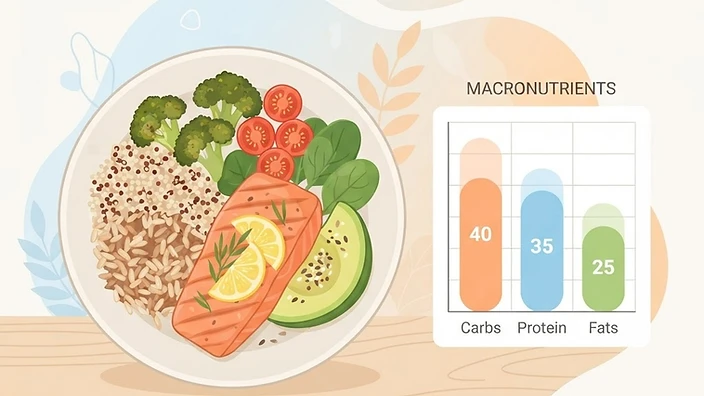 A balanced nutrition plate next to a macro breakdown chart
Step 1: Your BMR — the engine at idle
Even at complete rest, your body burns energy keeping your heart beating, lungs breathing, and brain thinking. This is your Basal Metabolic Rate (BMR). For most adults it accounts for 60–70% of everything they burn in a day.
The most common estimate is the Mifflin-St Jeor equation:
- Men: 10 × weight (kg) + 6.25 × height (cm) − 5 × age + 5
- Women: 10 × weight (kg) + 6.25 × height (cm) − 5 × age − 161
A 30-year-old woman who is 165 cm tall and weighs 65 kg has a BMR of roughly 1,391 calories — the energy she'd burn doing absolutely nothing for 24 hours.
Step 2: Multiply by your activity
Nobody lies in bed all day. Your BMR is multiplied by an activity factor:
- 1.2 — sedentary (desk job, little exercise)
- 1.375 — light (1–3 workouts per week)
- 1.55 — moderate (3–5 workouts per week)
- 1.725 — very active (6–7 workouts, physical job)
- 1.9 — athlete level
Our example woman who lifts weights three times a week has a maintenance level of about 1,912 × 1.375 ≈ 2,140 calories. Eat that, and her weight stays flat.
Step 3: Adjust for your goal
- Fat loss: a deficit of 300–500 calories per day (about 0.3–0.5 kg per week)
- Muscle gain: a surplus of 200–300 calories, paired with resistance training
Bigger deficits lose weight faster, but past ~25% below maintenance they start costing you muscle, energy, and adherence. Slow is genuinely better.
What about macros?
Calories decide whether your weight goes up or down; macronutrients decide how you feel and what you keep. A practical starting split:
- Protein: 1.6–2.2 g per kg of body weight — protects muscle, keeps you full
- Fats: about 25–30% of calories — hormones and vitamin absorption
- Carbs: whatever remains — fuels training and daily energy
The honest caveats
All calorie formulas are estimates. Real maintenance varies with sleep, stress, genetics, and how much you fidget. The fix isn't a better formula — it's feedback: eat at your calculated number for two weeks, watch the scale's average trend, and adjust by 100–200 calories. Your body is the final calculator.
Calorie & Macro Calculator
Estimate daily energy needs (Mifflin-St Jeor) and a balanced macro split for your goal.
Fill in your details to see your calorie and macro targets.
Once you know your number, pair it with your BMI and body fat percentage to see whether your plan is working — not just whether the scale moved.